A Treatise on Writing in the AI Age, Part 1
Last week, one of my blog posts was flagged on Dev.to.
I want to be clear that this series is not specifically about that event or the people involved. It’s a broader exploration of using AI during the writing process and rules around labeling any AI-assisted writing. This just happens to be a relevant example. Everyone was doing their job exactly the way the policy asked. That’s the point. A system can be staffed entirely by decent people and still be built wrong.
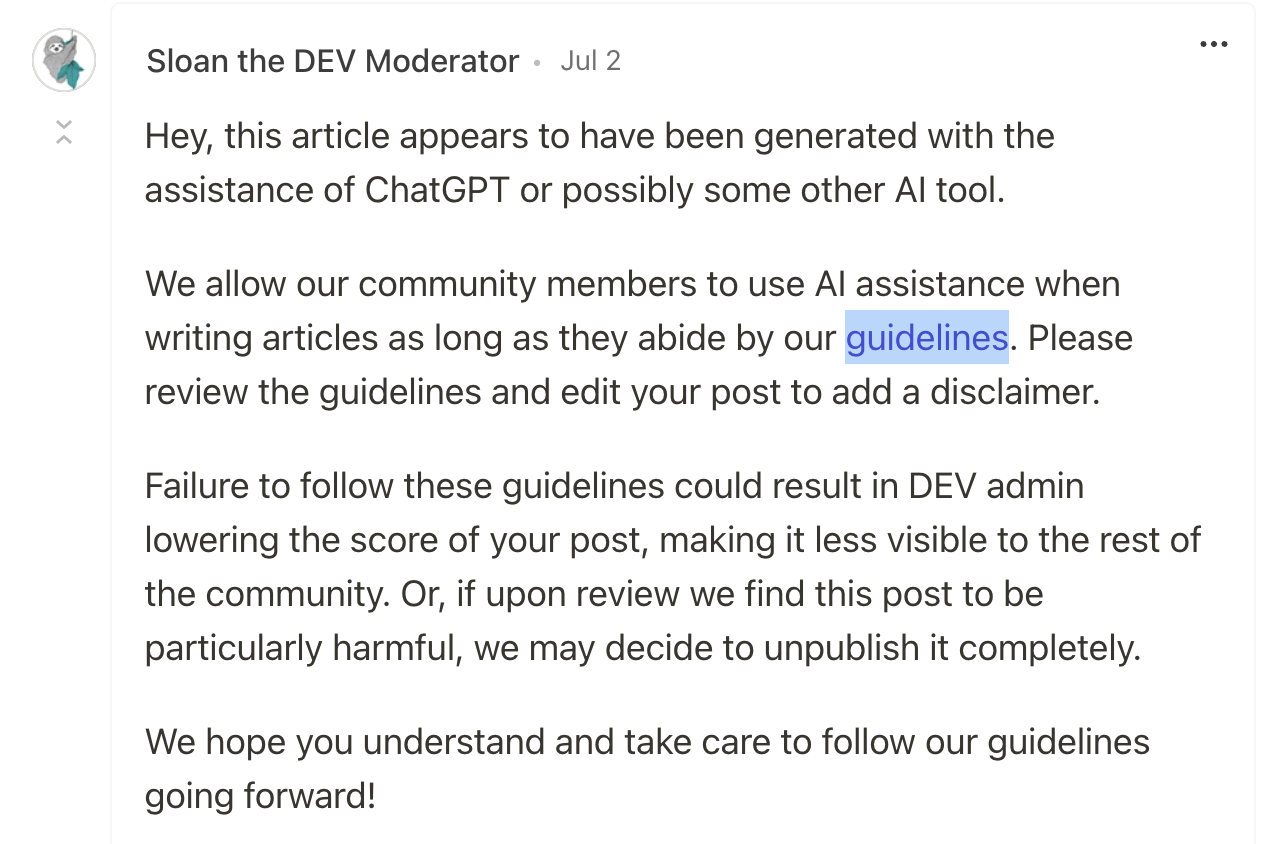
Did I use AI in the process? Sure, I have been almost since ChatGPT came out. It’s been my brainstorm partner, my editor, my devil’s advocate, research assistant, and more. But what’s remained the same in all of my work is that the ideas were mine, they’re driven by my own experiences, and the desire to share and teach others. I validated every piece of research myself, edited draft after draft, and shaped the whole thing into something I was proud to publish. Hours went into it. This wasn’t a drive-by prompt-and-paste. That’s not my M.O.
The irony still gets me. The post argued that reconstructing work from memory is lossy and that what you think happened is missing exactly what matters. That evidence beats confident guessing. None of the work I did is visible to the moderator. They had a feeling about my prose or it was flagged by some tool and a policy that told them to act on it.
I’ve spent the last 7 years helping developers find their people and their voice online. I’ve told hundreds of new writers that their perspective matters, that they should hit publish, that the community will meet them with generosity. So when a community I’ve championed looked at my work and saw a suspect instead of a writer, I didn’t just feel annoyed. I felt something closer to grief.
But this isn’t a post about my hurt feelings. It’s a post about a question we’ve stopped asking, and before moving into tech, I taught for years in my College English 101 classes.
Why do we write at all?
If we strip writing down to first principles, it does three things.
We write to communicate. To take something that lives in your mind and make it live in another.
We write to connect. Every blog post is a hand extended to a stranger. Someone reads your story when they’re going through the same thing and feels less alone.
And we write to think. Writing isn’t the transcript of thought. It’s the act of it. Anyone who has started an essay believing one thing and finished it believing another knows this.
Those are the ends writing serves. Which means they’re also the standard every writing rule should be judged against. Does this norm help ideas move between minds? Does it help people find each other? Does it deepen thinking?
The rule that fails its own test
A disclosure mandate doesn’t help communication. The label “AI-assisted” tells a reader almost nothing because it collapses an entire spectrum of uses into a single flag. Spellcheck, brainstorming, research support, and full generation all wear the same badge. A label that can’t distinguish between them isn’t information.
It doesn’t help connection either. Right now that label carries a stigma. It marks a writer as lesser, maybe even dishonest, before a single idea gets evaluated. Readers are trained to disengage the moment they see it. That’s not transparency building trust.
That’s a scarlet letter dressed up as a courtesy.
And it certainly doesn’t deepen thinking, because the platforms enforcing it have never asked about any of the other hands in our work. Nobody discloses Grammarly. Nobody discloses the friend who talked through the argument with them over coffee, or the editor who restructured the whole second half. Ghostwriting, where someone else writes every word, has been a respectable industry for a century. No badge required.
So the mandate isn’t really about protecting readers. If it were, it would target the things that actually betray them. Plagiarism. Ideas lifted without citation. Confident claims nobody checked. Those problems are rampant on the same platforms, and they go largely unpoliced while moderators guess at which sentences feel too polished.
This is a fear response, not a principle. AI made platforms afraid, and afraid institutions reach for visible rules over meaningful ones. A disclosure badge lets a platform look responsible without doing the harder work of caring about quality.
The test we should be using
You might argue that readers deserve to know how the sausage gets made. You’re not entirely wrong. Readers do deserve honesty. But honesty about what?
Not a tool inventory. Readers have never had one and never needed one. What readers deserve is a writer who stands behind the work. Who did the thinking. Who checked the claims. Who can defend every idea on the page because the ideas are actually theirs, regardless of which tools helped shape the sentences.
That post the moderator flagged? I own every word of it. I can defend every claim in it. That’s what my hours bought, and no label can add to it or take it away.
The test isn’t about origin. It’s about ownership.
That’s the claim this series exists to defend. In the essays ahead, I’ll dig into the double standard we’ve built around writing tools, the stigma machine that disclosure mandates power, the real quality problems platforms keep ignoring, and what a standard built on ownership would actually look like.
For now, I’ll leave you with the questions I keep returning to. When you read something that moves you, what were you actually trusting? The process, or the person? And if a rule can’t tell the difference between a writer who did the work and one who didn’t, what exactly is it protecting?
I don’t think we’ve answered that yet. I think it’s time we did.